DhwakaBaha.
A Conservation Project
THREADS OF HERITAGE
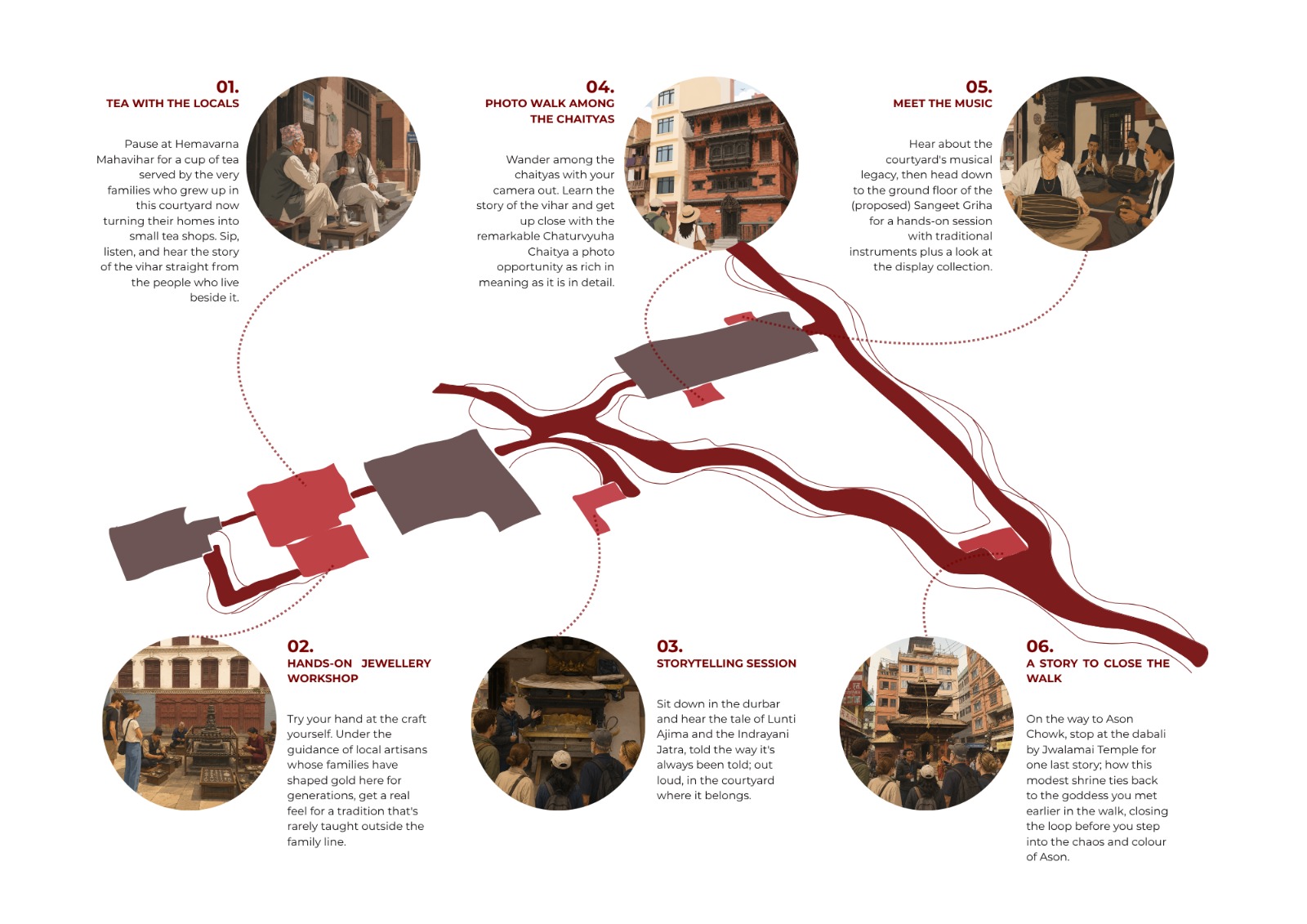
This heritage walk follows the threads of living heritage woven through the old city that connects courtyards, crafts, stories, architecture, music and rituals. From sharing tea with locals and creating traditional ornaments to listening to legends, exploring chaityas and playing heritage instruments, each stop offers a different way to experience the past. Walk the thread. Experience the heritage!
Starting Point
सुरुवात विन्दु
Namaste, and welcome! You’re standing at the edge of one of the oldest living neighbourhoods in Kathmandu. Over the next few hours, we’re going to walk through spaces that are sacred: some working and some still waking up to what they could become. Along the way you’ll drink tea where locals drink theirs, try your hand at a craft that’s rarely taught outside the family line, and hear stories that have been passed down by word of mouth for generations.
This is not a museum tour; everything you’re about to see is still lived in. People cook here, pray here and work here every single day. So as we walk, please keep your voice gentle, ask questions any time and most of all- enjoy being a guest here!
Let’s begin!
(Walking towards Gambahal)
-
01
Gambahal, Hemavarna Mahavihar
गम्बहाल, हेमवर्ण महाविहार
We’re now entering Gumbahal, home to Hemavarna Mahavihar, one of the eighteen great Mahaviharas of old Kantipur. This Vihar has stood here for over eight hundred years, right at the crossroads of Ason and Thahity, which used to be one of the busiest trade routes in the entire Kathmandu Valley.
Local memory says the very land beneath us was gifted to the Vihar’s first caretakers nearly eight centuries ago. Think about that for a second. The courtyard you’re standing on is older than most countries on the map today!
Now, before we move on, take a seat. The families who grew up right here in this courtyard have started opening small tea shops in their own homes. So, we’re going to pause, have a cup of tea together, and let them tell you the rest of the Vihar’s story themselves in their own words, the way it’s always been told.
(Tea break + Local Rendezvous 15 minutes)Whenever you’re ready, let’s continue to our next stop, to a courtyard where ornaments have been shaped by hand for over a hundred years.
-
02
Ornament making courtyard
गहना बनाउने चोक
Welcome to the courtyard where ornament-making has been continued as a profession for more than a hundred years. This courtyard has rung with the sound of ornament makers at work for what some people say a hundred and fifty years. Tap, Tap, Tap… that sound you’re hearing right now is the same sound this courtyard has made for generations.
This craft is passed hand to hand- father to son, master to apprentice, which is exactly why we call it a piece of ‘intangible heritage’. You can’t put it behind glass. It only survives if it keeps being practised.
And this is still very much alive. During festivals, locals still come here to have their jewellery made or repaired, just as their grandparents did.
Now, it’s your turn. We’ve arranged a short hands-on workshop with the artisans here. You won’t become a goldsmith in twenty minutes, but you will walk away with a real feel for a craft that most outsiders never get close to.
(Hands-on ornament making workshop. 20-25 minutes)Let’s move on now, to a durbar that belongs to a goddess with a truly unforgettable story.
-
03
Indrayani Durbar
इन्द्रायणी दरबार
This is Indrayani Durbar- home to the goddess Indrayani, known here by her local name, Lunti Ajima. She is one of the eight Astamatrikas, the fierce mother goddesses who are believed to encircle and protect the old city from every direction.
Let’s sit down here for a few minutes, because her story is worth hearing in full.
Indrayani was the daughter of Vatsala Maju, also known as Bhuvaneshwori, one of the most powerful goddesses in this valley. But, despite being born into that family, she was poor and her own mother and sisters looked down on her for it.
One year, at a family feast, her mother served her six sisters lavish meals on golden plates, but gave Indrayani and her children nothing but hard millet bread on leaf plates. When Indrayani asked why, she was mocked in front of everyone for her poverty.
Heartbroken, she left without touching the food and started walking home in tears. Her children, hungry and crying, kept pulling at her, until, unable to bear it any longer, she left each of them at a different spot along the road, one by one, until she reached Lagan completely alone.
There, an old woman took pity on her and handed her a single pumpkin. Indrayani carried it home, set it on the stove to cook, and broke down crying all over again, crying so hard through the night that she forgot the pot was even on the fire.
By morning, her house was filled with smoke. She rushed into the kitchen expecting to find it burnt. Instead, she found the pot overflowing with gold. It was a pot that never ran empty, no matter how much she scooped out.
But, Indrayani wasn’t greedy. She took only what she needed and let the risk sink into the Bishnumati river for anyone to find. This is why, even today, that stretch of river is known locally as ‘Lu Khusi’, the gold river. And that’s exactly how she earned her new name: Luti Ajima, ‘Lu’ meaning gold in the NEwar language.
Word of her sudden fortune spread fast, and the very family that had shunned her wanted her back at the table, but this time with the finest food and utensils, but Indrayani understood exactly what had changed. She took off her jewellery, placed it on the table in front of them, and told them plainly that their love was for her gold, not for her. Then, she walked away and never returned to that family’s feast again.
Instead, she started her own celebration, held months apart from her mother’s, without her mother or sisters present. That very celebration is still held today, called Bala Chahre, and it’s the heart of the Indrayani Jatra you may have heard about.
Even now, on the very first day of that festival, the doors of her temple are deliberately closed to keep out the family that once humiliated her. They only open again the next morning.
Nobody can say for certain who started this festival or exactly when, though many credit it to Gunakamadev, the Lichhavi king said to have founded Kathmandu itself. During the festival, there's also a rare snake oblation performed at her temple; an offering involving a pair of snakes along with fish, sparrows, and grasshoppers, a ritual otherwise seen in only a couple of other places in the valley. And on the new moon day, Indrayani is taken around the city to meet her consort, Swet Bhairav, at Chhetrapati. He used to travel to meet her in his own chariot, though that particular tradition faded away decades ago.
And her children? Five of them are honoured during the Jatra and brought to meet her from their own temples around the city, including one shrine we’ll visit ourselves at the very end of today’s walk of this section, to jwalamai Temple.
Keep her story in mind. We’ll come back to her family a little later. For now, let’s continue to our next destination, a courtyard with chaityas that speak their own tale of time.
-
04
Dhwaka Baha, Henakar Mahavihar
ध्वाखा बहा:, हेनाकार महाविहार
We’ve now arrived at Dhwaka Baha. Local tales suggest that “Dhwaka” comes from the idea of a gateway with five doors, symbolizing multiple access points connecting roads, bahas, and nearby chowks through cross-entrances. Another explanation links the term “Dhwaka” to the concept of a central door or entrance located within the middle of the baha, which gives the settlement its distinctive spatial identity and naming tradition. This is a historic Buddhist monastic courtyard that has long served as a religious, social, and communal space within the neighborhood. Beyond its spiritual significance, the Baha traditionally supported everyday community life, with locals recalling its use for activities such as drying paddy after harvest.
This is Henakar Mahavihar, which holds a significant position within the traditional Buddhist monastic matrix of the Kathmandu Valley, serving as one of the 18 primary Mahavihars of Kathmandu. Look at the entrance with me. You'll see two stone lions standing guard on either side. Just above the carved wooden doorway is a beautiful arch called a torana. Think of it as a carved 'signboard' announcing which deity lives inside. This one shows a deity called Dharmadhatu Vagishvara at the center, surrounded by six other tantric deities.
The main deity inside, called the kwapa-dya, meaning 'the principal god' in Newar tradition, is an image of Akshobhya Buddha, facing north. And on either side of the doorway, notice the two large stone figures that are Sariputra and Maudgalyayana, two of the closest disciples of the historical Buddha.
Now look up to the first floor. You'll see a row of five windows grouped together, called the Pasuka Jhya, with one smaller window on each side. This five-window arrangement is a classic feature you'll spot on religious buildings across the old city. Now, let’s move on to the stone Chaityas in front of this shrine. Each has its own story.
Chaturvyuha Chaitya
This 7th century stone chaitya wasn’t always standing here in the open. It was actually discovered buried, back in 1956, while the community was cleaning Ikha Pukhu, an old pond nearby, during Sithi nakha, an annual festival across the Kathmandu Valley dedicated to cleaning natural water sources. And here's the twist: this chaitya survived in such remarkably good condition precisely because it spent centuries buried underground, sheltered from weather, pollution, and wear. Walk around it slowly and look at each of its four sides. Each face shows a different Buddha or Bodhisattva looking outward, topped by a small carving of Amitabha Buddha in meditation, and framed by a decorative face carved above it called Kirtimukha, or 'Face of Glory', a guardian symbol you'll spot on temples all across the valley.
Facing East: Shakyamuni Buddha, the historical Buddha
Facing North: Vajrapani, a Bodhisattva of power and protection
Facing West: Maitreya, the 'Buddha still to come'
Facing South: Padmapani Avalokiteshwara, the Bodhisattva of compassion"Panchavaliyukta Chaitya
Its name simply means 'the chaitya of five layers' and if you look at it from bottom to top, each stacked tier represents one of five cosmic elements: water, lotus, jewel, fire, and space.
It also has four Buddha images, one facing each direction but this time they represent the Five Dhyani Buddhas, five 'meditation Buddhas' central to Buddhist belief:
Center: Vairochana
East: Akshobhya
South: Ratnasambhava
West: Amitabha
North: Amoghasiddhi"The Lichhavi Chaitya
This is one of the oldest chaityas, and honestly, you can tell just by looking at it. Its dome is rounded and quite worn down by time, sitting on a square stone base that still has a small niche carved into it, though that too has weathered heavily over the centuries. It dates back to the Lichhavi period, which makes it well over a thousand years old.
This chaitya has been raised up and placed onto a new, two-stepped stone platform. It is a small but meaningful conservation step taken to protect it going forward.One last thing before we move on. Beneath the ground right here in this courtyard rests ‘Lukma Dyo’, a deity that, quite literally, stays buried for almost the entire year. The community only uncovers it on a handful of special occasions, most notably during Shivaratri, when offerings are made directly to it before it's covered over once again. It's a good reminder that not everything sacred in this city is meant to be seen all the time. Some things are kept hidden on purpose, visited only once a year."
(Photo time among the chaityas, 15 minutes)Now, let’s head to a space in this courtyard that is still holding onto something very old.
-
05
Sangeet Griha
सङ्गीत गृह
For generations, this courtyard has kept alive a tradition of playing sacred and folk instruments during festivals, processions and everyday life here. The rhythm of this place has always been musical.
This house once used to host public gatherings on any special occasion of the residents within the courtyard and its vicinity. Moreover, it was a venue to learn musical instruments. Late Buwa, homeowner, was an enthusiast and a conservation activist of music. Even though Buwa is no more, Siddharth; his grandson has been learning music at such a young age hinting at the legacy and culture being carried forward by younger generations. Rather than letting this legacy fade into memory, a permanent home was given to the legacy where anyone can walk in, see it, hear it, and even try it for themselves.
This Sangeet Griha will let you do exactly that; to pick up traditional instruments and play them yourselves, along a display collection preserving the instruments of the past. Let is spend some time here now, hearing about the musical legacy of this courtyard and trying a few yourselves.
(Hands-on instrument session+ display viewing; 30 minutes)Now, we have one last stop before we reach the bustle of Ason that ties back to the story you already know.
-
06
Jwalamai temple
ज्वालामाई मन्दिर
This temple is Jwalamai temple. Remember the story of Luti Ajima we heard back at Indrayani Durbar, about the children she had to leave along the road that heartbroken night? Jwalamai is one of those five children, brought each year during the Indrayani Jatra to be reunited with her mother. That's how closely these two shrines, and these two stories, are woven together.
Let's sit here on the Dabali for a few minutes. This is where I'll tell you a little more about her, and her place in that family's story.
Jwalamai Temple stands here in Tyauda, right at the edge of Ason's centuries-old market. Take a moment to look up at it — it's a beautiful three-storey temple in classic medieval Nepali style, likely dating back to around the 16th century, crowned with a golden pinnacle and covered in some of the most intricately carved wooden frames, struts, and doors you'll see on this entire walk.
The goddess enshrined here is considered an incarnation of Parvati, and locally, she's known as Jwala Ajima, which translates to something like 'mother goddess' or 'grandmother.' She's especially trusted here as a protector against fire, believed to guard this neighbourhood from fire-related destruction, and she's also known to look after children and people with disabilities.
And here's where her story ties back to what we heard at Indrayani Durbar. According to local legend, Jwalamai is the second daughter of Indrayani herself, which is exactly why she's one of the five children brought here every year during the Indrayani Jatra, to be reunited with her mother.
Unfortunately, this temple hasn’t had an easy few years. It was damaged during the 2015 earthquake, and it’s worth remembering that heritage like this survives only when people choose to care for it.
And with that, our portion of the walk comes to its natural end right at the edge of Ason Chowk. From sacred courtyards to working craftsmen, from a goddess's golden pumpkin to instruments waiting to be played again, I hope this walk showed you a side of the old city that most people simply walk past without ever noticing.
Thank you for walking with us today. Namaste, and enjoy the rest of your walk.
Audio Guide
A short narrated walk through the baha, for listening on site.
Credits
Project
Group B4
Conservation Studio
Year V, Part-I
Batch 078
Institution
Department of Architecture
Thapathali Campus
Institute of Engineering
Tribhuvan University
Location
Dhwaka Baha
Kathmandu Metropolitan City
Nepal